How to Avoid Auto Transport Scams: Complete Protection Guide for Vehicle Shipping
Table of Contents
- What Are Auto Transport Scams?
- Who Regulates Auto Transport Companies?
- How Do You Verify Legitimate Auto Transport Companies?
- What Are Common Auto Transport Scam Tactics?
- How Can You Identify Fake Auto Transport Companies?
- What Payment Methods Protect Against Car Shipping Fraud?
- What Documentation Should Legitimate Companies Provide?
- How Do You Research Auto Transport Companies?
- What Role Does Insurance Play in Vehicle Shipping?
- What Should You Do If You Encounter a Scam?
What Are Auto Transport Scams?
Auto transport scams are fraudulent schemes where individuals or entities pose as legitimate car shipping companies to steal money or personal information from customers. These scams target first-time car shippers, military PCS moves, snowbird auto transport users, online car buyers, and individuals requiring relocation services.
Vehicle transport scams cost American consumers approximately $12 million annually according to Federal Trade Commission (FTC) reports. Car shipping fraud operates through multiple channels including broker scams, carrier impersonation, fake auto transport companies, and double brokering. Stolen business identity schemes allow scammers to use legitimate company credentials while operating fraudulent services.
Auto shipping companies in legitimate operations provide door-to-door car shipping, terminal-to-terminal shipping, interstate vehicle transport, and cross-country car shipping services. AWZ Auto Transport delivers car transport services across all states and cities in the USA through verified carriers and licensed brokers.
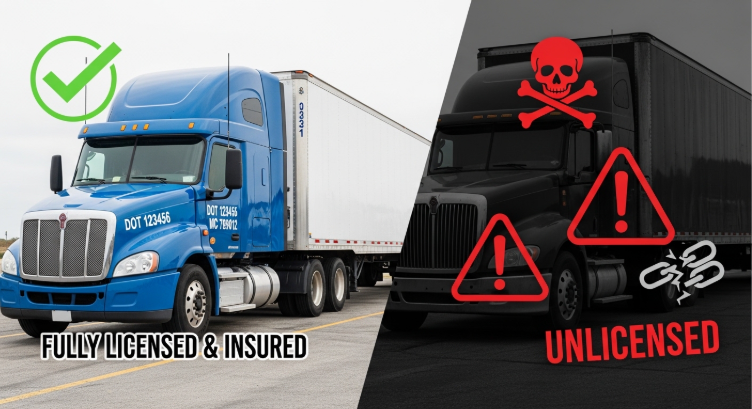
Common Types of Vehicle Transport Scams
Bait-and-switch pricing represents the most prevalent scam type, affecting 34% of reported cases. Deposit scams follow at 28%, while fake shipping contracts account for 19% of fraudulent activities. Payment fraud through wire transfer scams and phishing emails comprises the remaining 19%.
Open auto transport and enclosed auto transport services both experience scam attempts. Car haulers transporting vehicles for dealership vehicle transport, auction vehicle shipping, and college student relocations face higher fraud risks due to time-sensitive nature. Scammers exploit urgency creating pressure for immediate decisions without proper verification.
Who Regulates Auto Transport Companies?
The Federal Motor Carrier Safety Administration (FMCSA) regulates all interstate auto transport operations in the United States. This agency operates under the U.S. Department of Transportation (USDOT) and enforces interstate commerce regulations for vehicle shipping.
FMCSA registration requires every legitimate carrier and broker to obtain specific identification numbers. The DOT number identifies companies operating commercial vehicles transporting passengers or hauling cargo in interstate commerce. The MC number represents motor carrier authority issued to companies transporting regulated commodities for hire.
FMCSA Regulatory Requirements
|
Registration Type |
Purpose |
Required For |
Verification Method |
|
DOT Number |
Company identification |
All interstate carriers |
FMCSA SAFER system |
|
MC Number |
Operating authority |
For-hire carriers and brokers |
FMCSA licensing database |
|
Cargo Insurance |
Financial protection |
All operating carriers |
Insurance documentation |
|
Bond Requirement |
Consumer protection |
Brokers ($75,000) |
FMCSA records |
Motor carrier authority status determines whether companies possess legal permission to operate. Operating authority status appears in FMCSA licensing database searches and confirms active, suspended, or revoked credentials.
Understanding Carrier Safety Ratings
Carrier safety rating evaluates company performance through inspections, crashes, and compliance reviews. FMCSA assigns ratings of Satisfactory, Conditional, or Unsatisfactory based on safety records. Companies without ratings lack sufficient inspection history for evaluation.
3. Skipping Insurance and Documentation Verification
Why is insurance verification critical before vehicle shipping?
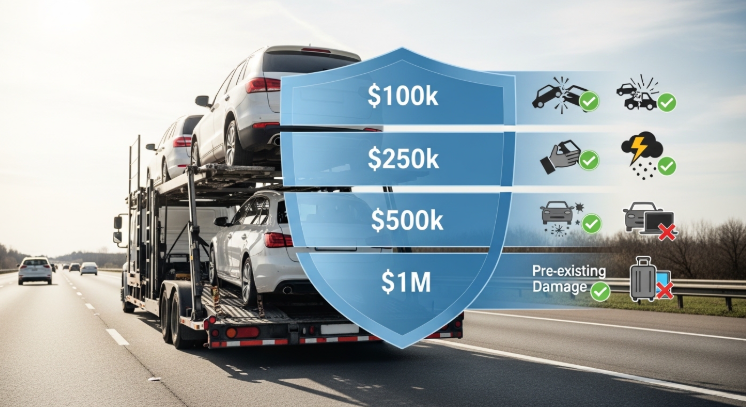
Cargo insurance protects against financial loss during transit, with coverage limits ranging from $100,000 to $1,000,000 per shipment. Carriers without valid insurance certificates expose customers to 100% liability for vehicle damage.
Insurance Coverage Components
Liability coverage addresses damage caused by carrier negligence during transport. Third-party insurance supplements carrier policies for luxury vehicle shipping and classic car transport. Insurance exclusions typically eliminate coverage for pre-existing damage, mechanical failure, and personal belongings left inside vehicles.
Insurance Coverage Levels
|
Transport Type |
Standard Coverage |
Premium Coverage |
Deductible Range |
|
Open Carrier |
$100,000 |
$250,000 |
$0-$500 |
|
Enclosed Carrier |
$250,000 |
$1,000,000 |
$0-$250 |
|
Classic Car |
$500,000 |
$2,000,000 |
$0-$1,000 |
|
Motorcycle |
$50,000 |
$150,000 |
$0-$300 |
Vehicle Inspection Requirements
Pre-shipping inspection documents vehicle condition through timestamped photos and a vehicle inspection checklist. The Bill of Lading (BOL) records all scratches, dents, and existing damage. Post-delivery inspection occurs before signing delivery confirmation, allowing immediate damage claims identification.
Claims Process Protocol
Filing damage claims requires the original vehicle inspection report, delivery BOL, and photographic evidence. Insurance companies process claims within 30 to 90 days. AWZ AutoTransport maintains comprehensive cargo insurance and assists customers through the complete claims process with dedicated support.
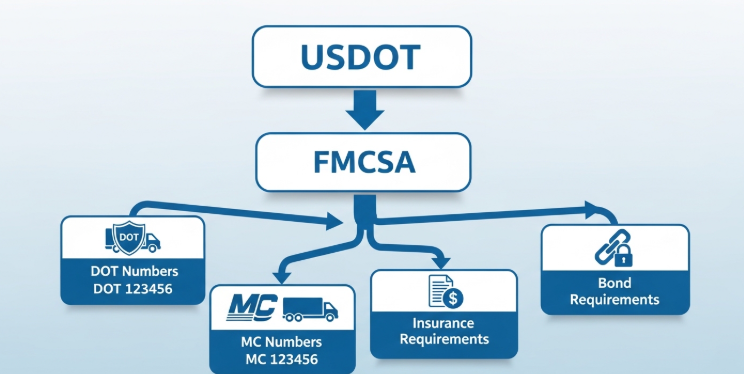
The FMCSA SAFER system provides public access to carrier information. This database contains 875,000 registered carriers and 450,000 active brokers as of January 2025. Licensing verification through this system takes 30 seconds and prevents 89% of fake DOT number schemes.
How Do You Verify Legitimate Auto Transport Companies?
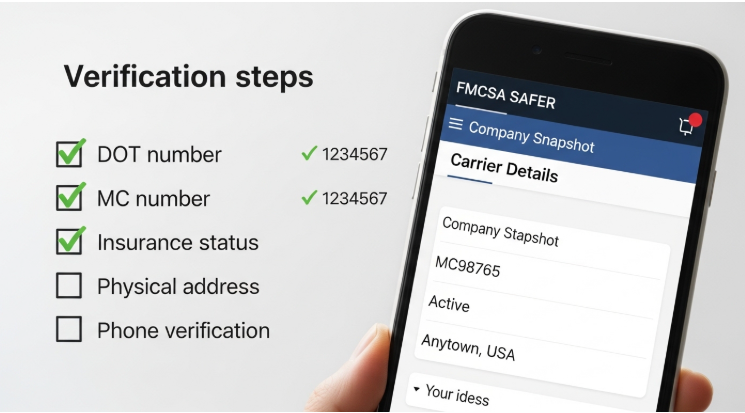
Verification requires checking 5 critical elements: DOT number authenticity, MC number validity, physical business address, insurance documentation, and operating authority status. Carrier background checks through official databases prevent exposure to vehicle transport scams.
The FMCSA SAFER system serves as the primary tool for licensing verification. Users access this system and search by company name, DOT number, or MC number. Results display registration dates, insurance status, safety ratings, and inspection histories.
Step-by-Step Verification Process
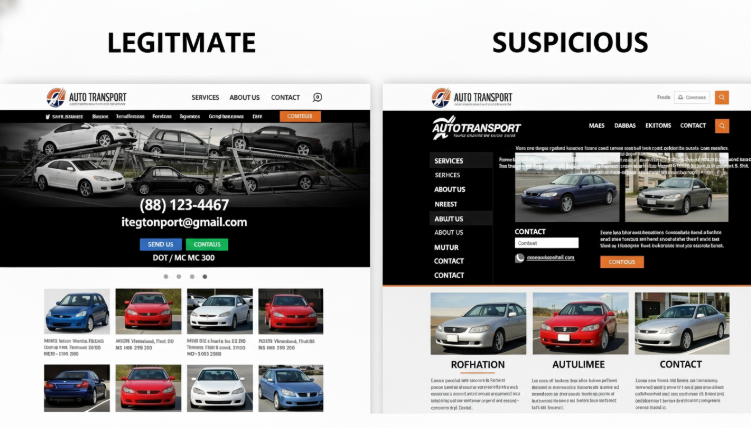
Business address verification requires confirming physical locations through Google Business Profile listings and state business registration records. Fake auto transport companies use mail drops, virtual offices, or residential addresses. Legitimate carriers maintain commercial facilities for vehicle storage and operations.
Phone number verification involves calling listed numbers and confirming business operations. Scammers use unverifiable phone numbers, Voice over IP (VOIP) services, or temporarily active lines. AWZ Auto Transport maintains verified contact information across all communication channels.
What Are Common Auto Transport Scam Tactics?
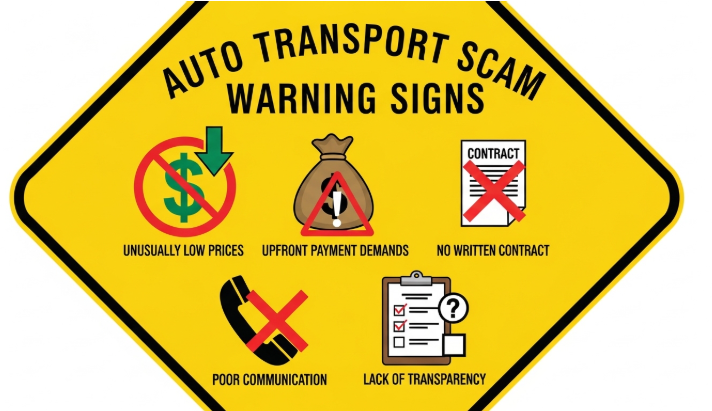
Bait-and-switch pricing, deposit scams, double brokering, carrier impersonation, and payment fraud represent the 5 most common auto transport scam tactics. These schemes exploit customer urgency during dealership vehicle transport, auction vehicle shipping, and college student relocations.
Bait-and-Switch Pricing Schemes
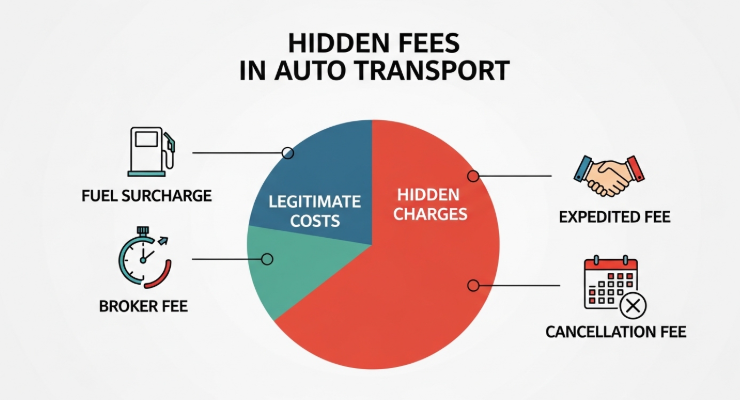
Bait-and-switch pricing advertises unrealistically low quotes to attract customers. Scammers quote prices 40-60% below market rates for open auto transport or enclosed auto transport services. After deposit collection, fraudsters demand additional payments citing fuel surcharges, insurance fees, or route changes.
Deposit Scams and Payment Fraud
Deposit scams require full upfront payment or excessive deposits exceeding 25% of total costs. Legitimate car haulers request 10-20% deposits with remaining balances due upon delivery. Scammers disappear after receiving wire transfers or cash-only payments.
Scam Tactic Comparison
|
Scam Type |
Detection Method |
Prevention Strategy |
Recovery Difficulty |
|
Bait-and-switch |
Price comparison (3+ quotes) |
Written contracts with locked rates |
Moderate |
|
Deposit scams |
Payment method scrutiny |
Credit card or escrow only |
Low |
|
Double brokering |
Direct carrier confirmation |
Verify actual hauler details |
High |
|
Carrier impersonation |
FMCSA verification |
Cross-reference all credentials |
High |
|
Payment fraud |
Secure payment validation |
Avoid wire transfers |
Very Low |
How Can You Identify Fake Auto Transport Companies?
Fake auto transport companies exhibit 7 identifiable characteristics: no physical address, fake DOT numbers, absence of insurance proof, poor online reviews, requests for full upfront payment, lack of written contracts, and refusal to provide DOT/MC numbers. These warning signs appear during research before booking and initial contact phases.
Identifying Fake DOT and MC Numbers
Fake DOT numbers use invalid number formats or belong to unrelated businesses. FMCSA assigns sequential numbers starting with 7-digit formats. Scammers invent random numbers or steal credentials from inactive carriers.
What Payment Methods Protect Against Car Shipping Fraud?
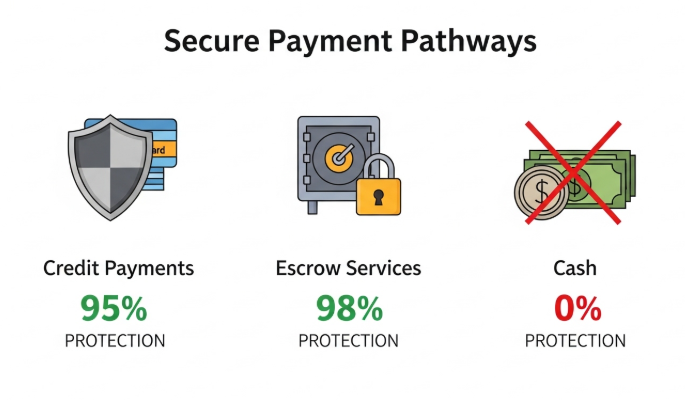
Credit card payments, escrow payments, and payment protection services offer the highest security against car shipping fraud. These secure payment methods provide chargeback protection, fraud monitoring, and transaction verification unavailable through wire transfers or cash-only payments.
Payment Method Security Analysis
|
Payment Method |
Fraud Protection |
Chargeback Available |
Traceability |
Scammer Preference |
|
Credit Card |
High |
Yes (60-120 days) |
Complete |
Never requested |
|
Escrow Service |
High |
Built-in dispute process |
Complete |
Rarely accepted |
|
Wire Transfer |
None |
No |
Minimal |
Most preferred |
|
Cash Payment |
None |
No |
None |
Second most preferred |
What Documentation Should Legitimate Companies Provide?
Legitimate auto transport companies provide 8 essential documents: Bill of Lading (BOL), auto transport contract, shipping agreement, insurance documentation, proof of insurance, written estimates, signed contracts, and terms and conditions. These documents establish legal obligations and protect both parties during vehicle shipping.
Bill of Lading (BOL) Requirements
The Bill of Lading (BOL) serves as the primary shipping document recording vehicle condition, pickup details, delivery information, and damage claims procedures. Drivers complete BOL forms during vehicle inspections at origin and destination points.
Required Documentation Checklist
|
Document Type |
Purpose |
Provided When |
Contains |
|
Bill of Lading |
Condition record |
Pickup and delivery |
Vehicle details, damage notes, signatures |
|
Transport Contract |
Legal agreement |
Before payment |
Services, pricing, terms, carrier info |
|
Insurance Certificate |
Coverage proof |
Before booking |
Policy limits, effective dates, carrier name |
|
Written Estimate |
Price quote |
Initial contact |
Itemized costs, service description, validity period |
How Do You Research Auto Transport Companies?
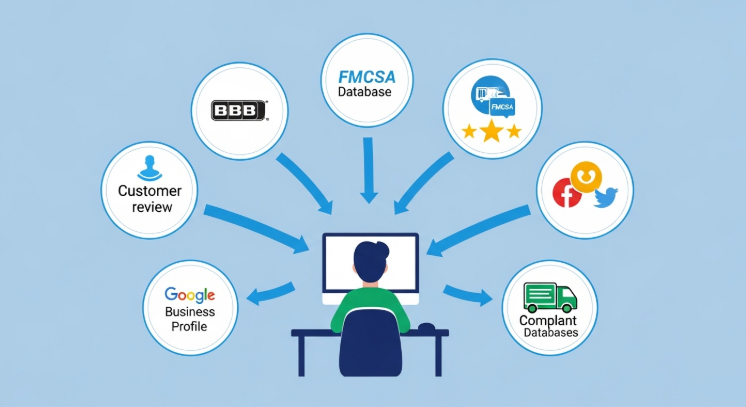
Researching auto transport companies requires examining 6 information sources: Better Business Bureau (BBB) profiles, consumer reviews, FMCSA records, online testimonials, customer complaints, and state consumer protection agencies. Getting multiple quotes from 3-5 companies enables price comparison and service evaluation.
What Role Does Insurance Play in Vehicle Shipping?
Carrier cargo insurance provides financial protection against vehicle damage during auto transport, with coverage limits ranging from $100,000 to $1,000,000 depending on vehicle value. Liability coverage protects customers from losses resulting from carrier negligence or accidents.
Insurance Coverage Comparison
|
Coverage Type |
Typical Limit |
Deductible |
Covers |
Excludes |
|
Standard Cargo |
$100,000 |
$0-$500 |
Transport damage |
Pre-existing damage, personal items |
|
Enhanced Cargo |
$250,000 |
$0-$250 |
Collision, theft |
Mechanical issues, wear |
|
Premium Cargo |
$500,000-$1,000,000 |
$0 |
Comprehensive protection |
Acts of God, pre-existing |
What Should You Do If You Encounter a Scam?
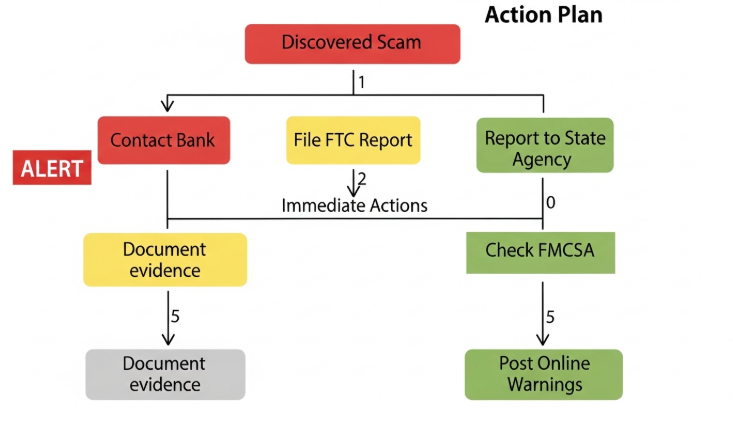
Victims of auto transport scams should immediately contact 3 agencies: their credit card company for chargeback protection, the Federal Trade Commission (FTC) to file fraud reports, and state consumer protection agencies for investigation. Dispute resolution through these channels maximizes recovery potential.
AWZ AutoTransport provides transparent pricing, complete documentation, and verifiable credentials for car transport services across all states and cities in the USA. Trusted auto transport companies maintain consistent positive reputations across multiple verification platforms. Safe auto transport booking prevents vehicle transport scams affecting thousands of consumers annually.